
Global Stock Market Hours, Timezones & Trading Overlaps: The Complete 2026 Guide
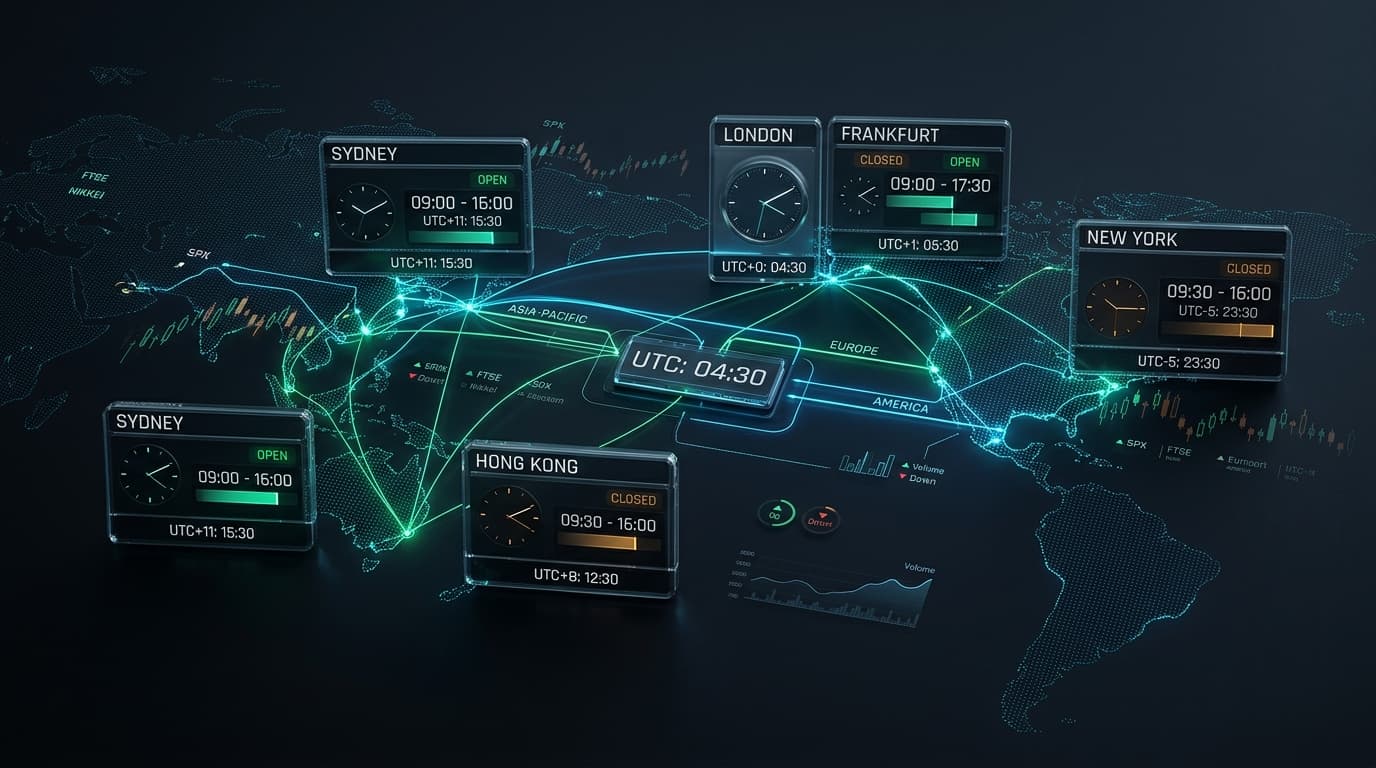
Global capital markets operate in a continuous, 24-hour relay race across timezones. From the opening bell of the Australian Securities Exchange (ASX) in Sydney to the closing auctions of the New York Stock Exchange (NYSE) and NASDAQ in Manhattan, billions of dollars in liquidity cascade through international exchanges.
For institutional traders, algorithmic developers, corporate treasurers, and global investors, knowing exact market hours, non-synchronized Daylight Saving Time (DST) shifts, and high-liquidity overlap windows is essential for minimizing slippage and managing execution risk.
Global Stock Market Countdown & Live Clocks
Monitor all 11 global exchanges in real-time with sub-second precision countdown clocks to the opening bell, mid-day lunch halts, and closing auctions. Features automated Daylight Saving Time (DST) recalculations and session overlap visualizers.
Master Global Stock Exchange Hours & Timezone Reference
Explore the interactive directory below to filter by continent, search by benchmark index, city, or exchange symbol, and track real-time open and closed market statuses across all 11 global exchanges.
Loading global market hours schedule...
Comprehensive Market Hours & UTC Mapping Table
The reference table below outlines standard continuous trading hours, local timezones, lunch halts, and standardized UTC conversions for the major international stock exchanges:
| Exchange | City & Country | Benchmark Index | Local Trading Hours | Lunch Break? | Standard UTC Hours |
|---|---|---|---|---|---|
| ASX | Sydney, Australia 🇦🇺 | S&P/ASX 200 | 10:00 – 16:00 AEST/AEDT | None | 00:00 – 06:00 UTC |
| TSE / JPX | Tokyo, Japan 🇯🇵 | Nikkei 225 | 09:00 – 11:30 / 12:30 – 15:30 JST | 11:30 – 12:30 JST | 00:00 – 02:30 / 03:30 – 06:30 UTC |
| HKEX | Hong Kong 🇭🇰 | Hang Seng Index | 09:30 – 12:00 / 13:00 – 16:00 HKT | 12:00 – 13:00 HKT | 01:30 – 04:00 / 05:00 – 08:00 UTC |
| SGX | Singapore 🇸🇬 | Straits Times (STI) | 09:00 – 12:00 / 13:00 – 17:00 SGT | 12:00 – 13:00 SGT | 01:00 – 04:00 / 05:00 – 09:00 UTC |
| NSE / BSE | Mumbai, India 🇮🇳 | Nifty 50 / Sensex | 09:15 – 15:30 IST | None | 03:45 – 10:00 UTC |
| FWB / XETRA | Frankfurt, Germany 🇩🇪 | DAX 40 | 09:00 – 17:30 CET/CEST | None | 07:00 – 15:30 UTC |
| Euronext | Paris / Amsterdam 🇪🇺 | CAC 40 / AEX | 09:00 – 17:30 CET/CEST | None | 07:00 – 15:30 UTC |
| SIX | Zurich, Switzerland 🇨🇭 | SMI 20 | 09:00 – 17:30 CET/CEST | None | 07:00 – 15:30 UTC |
| LSE | London, United Kingdom 🇬🇧 | FTSE 100 | 08:00 – 16:30 GMT/BST | None | 08:00 – 16:30 UTC |
| NYSE / NASDAQ | New York, United States 🇺🇸 | S&P 500 / NASDAQ 100 | 09:30 – 16:00 EST/EDT | None | 14:30 – 21:00 UTC |
| TSX | Toronto, Canada 🇨🇦 | S&P/TSX Composite | 09:30 – 16:00 EST/EDT | None | 14:30 – 21:00 UTC |
The Critical Liquidity Overlap Windows
Market volatility, institutional block trades, and order execution volume are not evenly distributed throughout the trading day. They spike dramatically during cross-continental session overlaps:
London & New York Overlap
Generates ~70% of total daily global Foreign Exchange (FX) volume and the majority of trans-Atlantic equity arbitrage.
- US Morning Open Volatility: At 9:30 AM EST (13:30 UTC), US institutional participants react to morning macroeconomic releases (CPI, Non-Farm Payrolls, FOMC decisions) while European desks are in their afternoon session.
- European Closing Cross: At 16:30 London Time (15:30 UTC), European indices conduct their official closing auction, sparking concentrated hedging transactions across US equity indexes and futures.
Tokyo & London Hand-Off
The critical transition bridge between Asian closing settlement books and European morning order intake.
- Cross-Continent Price Transmission: As Japanese and Hong Kong equities enter their final afternoon matching run, London and Frankfurt open their morning books, instantly reflecting Asian overnight performance into European asset prices.
- Currency Cross Liquidity: High volume spikes in EUR/JPY, GBP/JPY, and commodity crosses as hedge funds reposition based on morning European economic indicators.
Asia-Pacific Synchronized Window
The regional core session driving primary price discovery for global commodities, mining equities, and APAC tech supply chains.
- Coordinated Regional Execution: All four major Asia-Pacific financial centers trade concurrently, establishing the foundational global market sentiment and risk-on/risk-off tone for Western markets.
- Commodities & Mining Arbitrage: ASX resource giants (BHP, Rio Tinto) trade in tandem with Tokyo industrial counters and Hong Kong tech conglomerates.
Detailed Breakdown of Overlap Windows
1. The London & New York Overlap (13:00 – 16:00 UTC)
The overlap between European and North American trading sessions represents the single highest liquidity window in global finance. Approximately 70% of total daily foreign exchange (Forex) volume and substantial cross-listed equity arbitrage occurs during these 3 to 4 hours.
- US Opening Volatility: Between 9:30 AM and 11:30 AM Eastern Time (13:30 – 15:30 UTC), US markets absorb pre-market economic announcements while London is in its afternoon session.
- European Closing Auction: At 16:30 London Time (15:30 UTC), the European market closing auction triggers massive index rebalancing and derivatives hedging.
2. The Tokyo & London Hand-Off (07:00 – 08:30 UTC)
As Japanese and Hong Kong exchanges conduct their final afternoon settlement runs, Frankfurt and London open their morning order books. Macroeconomic indicators from Europe interact directly with Asian session closing sentiment.
3. The Asia-Pacific Synchronized Window (01:30 – 06:00 UTC)
During this window, Australia, Japan, Hong Kong, and Singapore are all simultaneously active. This period sets the benchmark tone for global risk assets, commodities, and APAC equity indices.
Continuous Matching vs Mid-Day Lunch Halts
A key structural difference between Western and Asian stock exchanges is the concept of the mid-day lunch break:
- Continuous Trading (Western Exchanges): Exchanges like the NYSE, NASDAQ, LSE, and Euronext trade continuously from opening to closing bell without interruption. High-frequency market makers (MMs) and algorithmic liquidity providers maintain two-sided order books throughout the session.
- Split Sessions (Asian Exchanges): Exchanges such as Tokyo (TSE), Hong Kong (HKEX), and Singapore (SGX) pause trading for 60 to 90 minutes in the middle of the day. This tradition gives brokers and specialists time to settle morning contracts, review lunchtime corporate filings, and establish fresh opening orders for the afternoon session.
Architectural Challenges in Engineering Financial Clocks
Building accurate, low-latency financial clocks like our Global Stock Market Countdown Tool presents unique software engineering hurdles:
1. The Asymmetric Daylight Saving Time (DST) Problem
Not all countries change their clocks on the same date, and several jurisdictions do not observe DST at all (e.g., Japan, Singapore, Hong Kong, and Queensland/Western Australia).
- North America: The US and Canada transition to Daylight Saving Time on the second Sunday in March.
- Europe: The UK and European Union transition on the last Sunday in March (creating a 2-week gap where US-EU market overlaps shift by 1 hour).
- Southern Hemisphere: Australia transitions to Standard Time on the first Sunday in April (moving in the opposite seasonal direction).
Architectural Solution: Hardcoding fixed UTC offsets in financial applications leads to critical timing errors. Modern applications must leverage the IANA Time Zone Database via native ECMAScript
Intl.DateTimeFormator server-side timezone parsers to resolve dynamic offsets on demand.
2. Client Device Drift & NTP Synchronization
Browser clocks frequently drift by several seconds or minutes depending on the user's local operating system settings. For financial applications, calculating market countdowns against the raw local client clock can lead to false open/closed statuses.
Architectural Solution: Compute timezone offsets using deterministic calendar mathematics based on reference UTC timestamps, and synchronize clock deltas on page hydration against authoritative NTP server headers.
Track Global Exchanges in Real Time
Whether you are tracking the opening bell of Wall Street, waiting for the ASX closing cross, or planning cross-market hedging strategies, you can monitor all active sessions directly on our live platform.
Explore the Global Stock Market Countdown & Live Clocks Dashboard for real-time countdown timers, lunch break tracking, and session progress meters.
Need Custom Financial or Real-Time Cloud Infrastructure?
AgenorIT architects high-throughput financial data pipelines, Azure low-latency cloud infrastructure, and enterprise AI automation agents for Australian and global businesses.
Book a Technology Consultation with Gurinder Singh to discuss your digital platform roadmap.
Written by Gurinder Singh
AuthorPrincipal Cloud & Software Architect at AgenorIT. Specialising in Microsoft Azure Landing Zones, Microsoft Entra identity architectures, Microsoft Fabric lakehouses, and high-performance digital products for Australian organisations.
Related Architecture & Engineering Insights
Azure AD B2C to Entra External ID Migration Guide: Architectural Patterns & Cutover Strategy
Step-by-step engineering guide to migrating Azure AD B2C to Microsoft Entra External ID with zero user downtime, JIT password migration, and token mapping.
Azure Landing Zone Cost in Australia: 2026 Implementation & Consumption Guide
Understand Azure Landing Zone implementation costs in Australia. Compare architecture drivers, subscription sizing, IaC accelerators, and Azure cloud spend.
Need Senior Architecture Guidance on Your Platform?
Speak directly with an experienced engineer about cloud infrastructure, data pipelines, or software development.